February 12, 2026
3 min read
Fact-checked by Stoyan Todorov
Michigan Gov. Whitmer Proposes Online Casino Tax Hike
Furthermore, nearly all Michigan iGaming operators would lose the ability to deduct promotional credits from gross revenue starting in 2027.
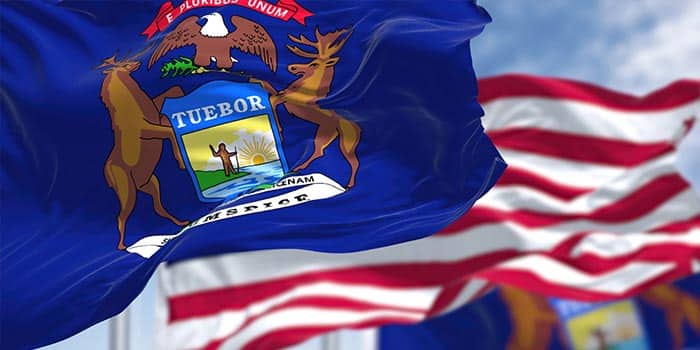
Earlier this week, Michigan Gov. Gretchen Whitmer proposed increasing the state’s highest online casino tax rate by eight percentage points to 36% as part of her Fiscal Year 2027 budget.
Governor Proposes Tax Increase
Her proposal also includes a widely criticized per-wager surcharge on mobile sports betting, mirroring the structure adopted in Illinois. Under the plan, operators would pay 25 cents on each of the first 20 million bets placed, and 50 cents on every wager beyond that threshold. It is expected that Whitmer’s proposal for a per-wager surcharge is projected to raise $38.8 million in revenue for the state.
Currently, Michigan online operators pay monthly progressive rates ranging from 20% to 28% based on adjusted gross revenue (AGR) figures. The first $4 million AGR is taxed at a 20% rate before increases of two percentage points at $8, $10, and $12 million. Operators then pay the cap of 28% rate on all winnings when they exceed $12 million. According to the General Briefing Papers, only three operators – FanDuel, BetMGM, and DraftKings – surpassed the threshold last year that triggers the top 28% tax rate on adjusted gross revenue exceeding $12 million. However, some mid-tier operators, such as BetRivers, began consistently exceeding that mark in 2025.
It should also be noted that with Gov. Whitmer‘s proposal, nearly all Michigan iGaming operators would lose the ability to deduct promotional credits from gross revenue starting in 2027, which would mark their sixth year of operations for most. Original licensees can deduct up to 4% this year, down from 6% in 2025 and 10% from launch in 2021 through 2024.
Could Illinois Be a Warning for this New Policy?
The new proposal is notable given the strong backlash and subsequent year-over-year decline in betting volume seen in neighboring Illinois. There, sportsbooks reported their steepest monthly drop in handle since the surcharge was implemented, with wagering falling nearly 25% in December after declines of more than 15% in September, October, and November.
The proposal also follows a year in which Michigan’s sports betting handle was essentially flat. In 2025, total wagers reached $5.54 billion, an increase of just 0.6% compared to 2024. By comparison, Illinois posted 11.6% year-over-year growth to $15.65 billion, even amid its recent slowdown in betting activity. Despite that growth, however, Illinois is reconsidering its gambling tax policy right now. If the state does so, it would essentially confirm the operator’s warnings that higher taxes on gambling would have a negative effect on betting.
But back to Michigan, it should be noted that these effects might not be as severe as in Illinois, as Michigan operators, though, only pay 8.4% in state taxes on AGR, which is among the lowest in the US. Therefore, an increase in the gambling tax, while it might lead to a decrease in overall bets, might not lead to a very large decline in operator revenue.

Stefan Velikov is an accomplished iGaming writer and journalist specializing in esports, regulatory developments, and industry innovations. With over five years of extensive writing experience, he has contributed to various publications, continuously refining his craft and expertise in the field.

Next Article


Casino
February 12, 2026
CFTC’s Favorable Stance on Prediction Markets Sparks State Backlash
Must Read
Casino
March 25, 2026
Philippines Steps Up Action Against Online Gaming Crime
Casino
March 25, 2026
No Break: 6ix9ine Wins $50K Blackjack Hand From Prison
More Articles


Slots
March 27, 2026
The Outlaws Are Back in NetEnt’s Dead or Alive 3 Slot Game


Poker
March 27, 2026
WSOP Set to Return on ESPN Once Again


Poker
March 27, 2026
From Poker Cash to 30 Stores: Fat Shack Founder Story
Industry
March 27, 2026
Rift Between AGA and Sportsbooks Grows, as Bet365 Quits






Casino
March 27, 2026
Las Vegas Set for Likely Super Bowl Return in 2029